Project-based education without textbooks, with a grip on every learning goal
Maius links your projects to core goals and the exam programme, lets students provide evidence and makes progress and progression visible per learning goal. For students, teachers and school leaders.



Project-based education works. The overview is the hard part.
Without textbooks, nothing fixes which learning goals come up when. That gives freedom, but also raises questions.
Overlap between projects stays invisible and gaps in the curriculum are discovered too late. With the new core goals, a school must be able to show exactly that.

An average grade per subject says little when students work in projects. You want to know per learning goal what a student has mastered, and what not yet.
Evidence sits in folders, emails and loose documents. Writing feedback per student on dozens of learning goals is unsustainable for teachers.
From learning goal to progression, in one system
Maius connects what is separate in other systems: the curriculum, the projects, the student's evidence and the teacher's assessment.
-
1
Set the learning goals
Core goals, exam programme or own goals, organised in domains and learning goal maps with steps per level.
-
2
Link projects to learning goals
Per project you see which learning goals it covers, including the phases of design thinking. Overlap and gaps become immediately visible.
-
3
Students provide evidence, teachers give feedback
The student submits work for a learning goal or for the whole project; Maius works out which learning goals it contributes to. The teacher assesses per student or for a whole group at once.
-
4
Track progress and progression per learning goal
Students see for themselves what percentage they have mastered. Mentors and school leaders get reports per student, group or learning goal.
One system, three users
School leadership
- See which core goals and exam material your projects cover.
- Substantiate progression per learning goal, including to another school track.
- Reports for accountability and team discussions.

Teacher and mentor
- The Signpost: choose a student or group and go straight to the right learning goals.
- Assess a whole group at once and see immediately who has new feedback.
- Claude analyses the evidence beforehand; you assess and have the final say. How it works

Student
- Your own Signpost: what's new from the teacher, what is almost achieved, and quickly to your learning plan, projects and domains.
- A dashboard with your own progress per domain and per project.
- A personal learning plan: working at your own pace and level.
- Evidence, reflection and teacher feedback in one place.
"... kijkt hij met enige jaloezie naar MAIUS: een leerlingvolgsysteem waarbij leerlingen zelf zien hoeveel procent ze beheersen ..."
School portrait of Tienerschool Spring High by Rob van der Poel, Nivoz foundation (quote in Dutch)
Spring High, Amsterdam
A school for teenagers with 350+ students. Progression was per learning goal, seamlessly towards the right Dutch school track (mavo, havo or vwo). SLO (the Dutch national curriculum institute) made several reports about it.
Computer science in projects
Schools using the Maius approach reached the final of the Raspberry Pi Competition with two teams in 2024, and with three in 2025.
College Rolduc, Kerkrade
Learning goals achieved in cross-curricular projects. With Maius the team avoided overlap between projects and safeguarded alignment with the curriculum.
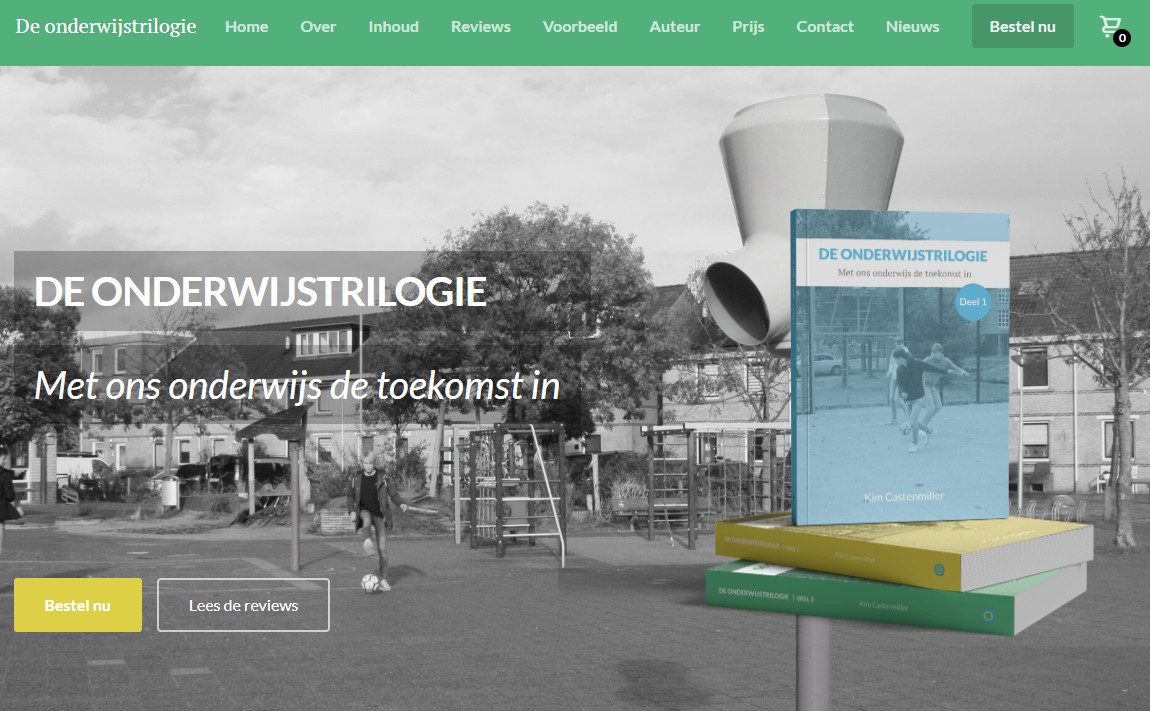
De Onderwijstrilogie
"... omschakelen naar projectonderwijs zonder methoden vroeg om een nieuw houvast ..."
The role of Maius in the book by Kim Castenmiller (2025).


Computer science in projects, even when teachers are scarce
The computer science exam programme has a core and twelve elective domains. That calls for tailor-made solutions, while many schools struggle to find computer science teachers.
Ask about the computer science approachLearning goals and projects
- Learning goals for the core domains and the elective domains.
- Projects with design thinking, ready to link.
- Students choose their own route through the elective domains.
Become a computer science teacher
A practice-oriented training for teachers who are already qualified: subject content, didactics and project-based education.
More about the trainingOwn goals, own projects, own approach. AI does the pre-analysis, the teacher assesses.
In tailor-made education every student works on their own combination. There is no answer key. The heavy work is not marking, but working things out: which evidence belongs to which learning goal, and what does it show? Maius lets Claude do that groundwork.
 Learning goals
 Projects
 Evidence


You can start small
Start, for example, with one department or one year group, and expand when it works.
Quickly set up
- Log in with SURFconext, Microsoft or Google.
- Import students and groups from Excel.
- Create projects with a step-by-step plan.
Coaching for the team
We help set up learning goals and projects, in line with your school's vision, and coach teachers in working with Maius.
More about our offeringPrivacy and security
Maius runs on servers in the Netherlands, at an ISO 27001-certified hosting partner. We only process data that is needed for education and do not share data with commercial parties.
Read the privacy statementCurious how this would work at your school?
In a demo we show Maius with projects and learning goals that fit your school.